Why
6120?
Why the 6120?
A vivid orange body.
The rich resonance only a hollow body can give.
Bigsby. Filter’Tron.
And a story handed down across generations.
Not just a guitar with a long history —
a guitar that has kept evolving alongside its players.
1954 — TODAY
GRETSCH 6120 / HISTORY & CHARACTER
The Gretsch 6120 is not just a guitar with a long history. From Chet Atkins, Eddie Cochran, Duane Eddy and Brian Setzer onward, generation after generation of guitarists have picked up the 6120, and each has written this model’s history through their own music.
They all share the name “6120,” yet a 1955, a 1959 and a 1960s 6120 differ in looks, construction and sound.
01
THE BEGINNING
Chet Atkins and the birth of the 6120
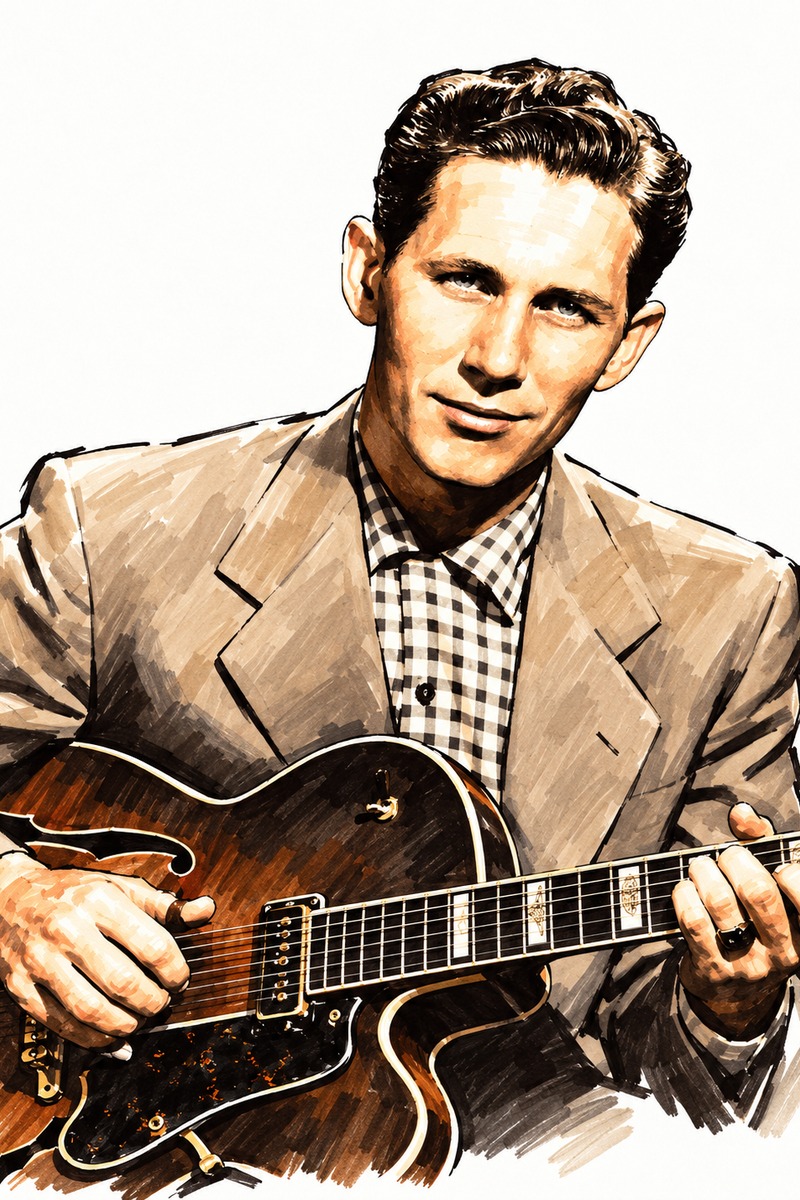
CHET ATKINS
THE BEGINNING OF 6120
1954
The story begins in 1954.
The 6120 was born from a partnership between Gretsch and Chet Atkins, who by then was already one of the leading figures in country guitar.
According to Gretsch’s official history, Chet Atkins and Fred Gretsch Jr. signed their agreement in July 1954. After prototype development, the Chet Atkins Hollow Body Model 6120 began shipping to dealers in January 1955.
The early 6120 had a striking personality you could spot at a glance: a vivid orange body, the “G” brand, and Western-themed fingerboard inlays.
Interestingly, Chet himself wasn’t necessarily fond of the Western trappings.
Even so, he worked with Gretsch to make a better electric guitar, proposing many ideas on playability, sound and construction.
The 6120 was not a finished guitar from day one.
It was a guitar that Chet Atkins and Gretsch kept refining as they played it.
02
EVOLUTION
A “6120” is not the same 6120 every year.
Same name.
Different
character.
To know the year
is to know the guitar.
One of the fascinating things about the vintage 6120 is how much its specifications changed over the years.
While keeping the same model number, “6120,” its pickups, fingerboard inlays, bracing, vibrato and body shape changed one after another within just a few years.
Simply following the guitars documented in the sources we referenced makes those changes clear.
| MODEL YEAR | Key features |
|---|---|
| 1955 | The early 6120. G brand, Western motifs, DeArmond pickups and other early-model specs |
| 1956 | Continued small changes to the headstock, inlays, vibrato and hardware. Several specs can exist within the same year |
| 1957 | The G brand begins to disappear; later, a shift to Filter’Trons, ebony fingerboards and Neo-Classic-style inlays |
| 1958 | Filter’Trons, Neo-Classic inlays, trestle bracing — the specs that define the later 6120 come together |
| 1959 | Arguably the final form of the 1950s single-cutaway 6120. Still one of the most sought-after years |
| c. 1961–62 | A major change to the Electrotone style, with a thinner body and a double cutaway |
Gretsch itself explains that in 1958, driven by Chet Atkins’s requests, the Filter’Tron, Neo-Classic inlays and trestle bracing appeared.
Trestle bracing was designed to increase sustain while reducing feedback in a hollow body.
Then around 1961–62, Gretsch made a major design change to the Electrotone style, with a thinner body and a double cutaway.
That’s why, with the 6120, the year it was made matters so much.
03
WHY 1959?
Why is the 1959 6120 so special?
When telling the history of the 6120, 1959 is one year you can’t skip.
One of its iconic players is Brian Setzer.
According to Brian Setzer, the 1959 6120 he played for years in the Stray Cats has been retired from front-line duty after decades of hard use, but it remains a very special guitar to him.
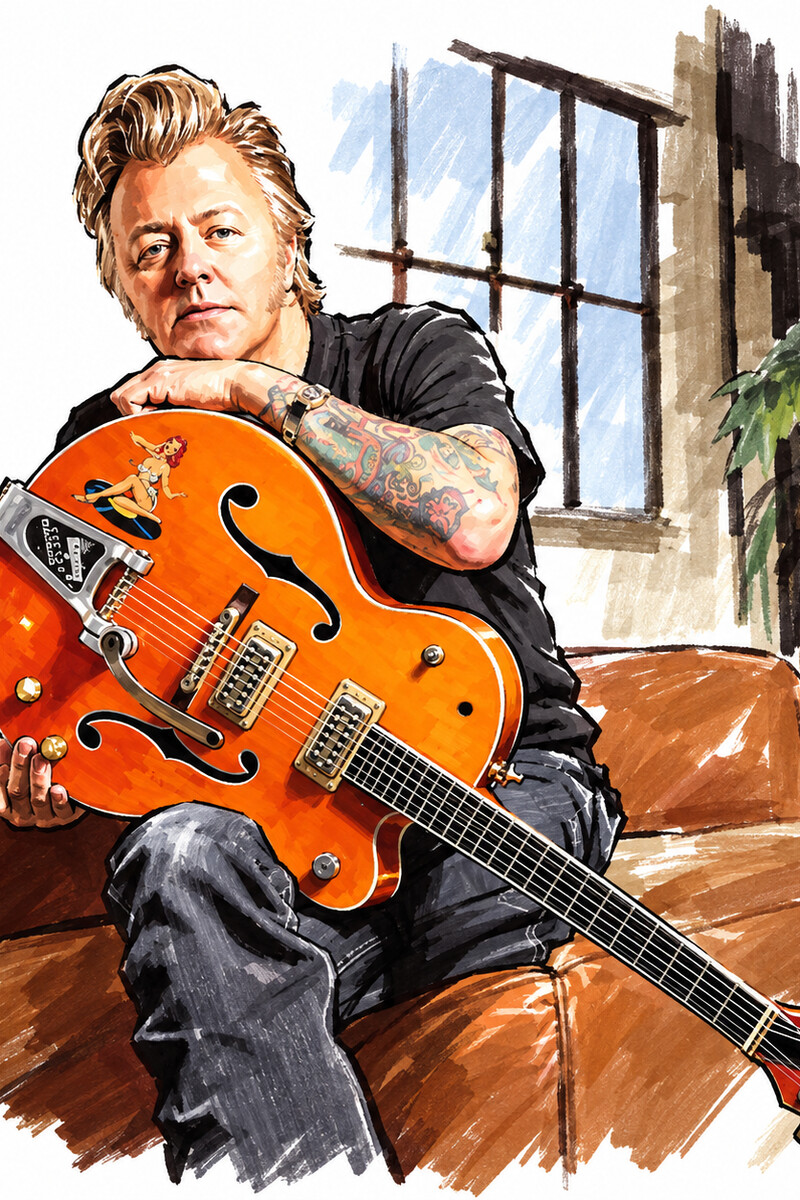
BRIAN SETZER
STRAY CATS
1959
He has also offered an intriguing explanation, based on his own experience, of how the 1958 and 1959 models differ in construction and resonance.
According to Setzer, the 1958 6120s he has played feel as though the bracing inside the body holds back the top’s vibration, while with a 1959, standing in front of the amp, it feels like the whole guitar is vibrating.
He sees the difference as a difference in resonance created by the body top and the bracing.
Of course, this doesn’t mean that every 1958 and every 1959 is the same.
Vintage Gretsches vary from guitar to guitar, and some were built during transitional periods between spec changes.
This is Brian Setzer’s own view as a player, drawn from the 6120s he has actually played.
Even so, his words are fascinating when you consider why the 1959 6120 draws so many players.
Like part of my own body
Brian Setzer
Once you pick it up and start playing, you don’t have to think about anything else.
Becoming that much at one with the player —
that, too, may be part of the magic of the 6120.
04
THE SOUND OF 6120
A hollow body, yet a guitar built to be played on stage.
HOLLOW BODY
FILTER’TRON
BIGSBY
BRACING
A hollow body
built for the stage.
It’s hard to capture the sound of the 6120 in a single word.
- The resonance unique to a hollow body, where even the air inside vibrates.
- The clear, well-defined sound of the Filter’Tron.
- The distinctive vibrato of the Bigsby.
- And the body resonance controlled by its bracing.
Especially in the late-1950s 6120s, Gretsch kept experimenting to meet seemingly contradictory demands: keeping the rich resonance of a hollow body while increasing sustain and reducing feedback.
Gretsch also explains that trestle bracing tied the top and back together more firmly, improving sustain and feedback resistance while preserving a true hollow-body tone.
In other words, the 6120 is not just a “box.”
How do you bring a hollow body’s voice to the stage as an electric guitar?
The 6120 is a guitar that kept chasing that answer.
05
SERIAL NUMBER
Reading a 6120 by its serial number.
Read
the number.
Find
the story.
A serial number is not “the answer”
but “a clue.”
Body shape, pickups,
inlays, bracing.
Read it together with
the details of the guitar.
When researching a vintage 6120, the serial number is one of the most important clues.
On 1950s hollow-body Gretsches, the serial number is written on the Gretsch label inside the body, and on many guitars it can be seen through the f-hole.
There is one caution, however.
A Gretsch’s year can’t always be determined from the serial number alone.
Spec changes at the time didn’t line up neatly with the calendar year, and model years or transitional periods could create gaps between when a guitar was made and how it looks or is specified.
That’s why at 6120.jp we believe it’s important to look at each guitar as a whole — not just the serial number, but
serial number × body shape × pickups × inlays × bracing × hardware
and more.
1954–1965 SERIAL NUMBER GUIDE
Approximate dates from serial numbers
For the 1950s through the early 1960s, the range of the serial number lets you estimate roughly when a guitar was made.
| SERIAL NUMBER | APPROX. YEAR |
|---|---|
| 90xx–130xx | 1954 |
| 130xx–180xx | 1955 |
| 180xx–210xx | 1956 |
| 210xx–260xx | 1957 |
| 260xx–300xx | 1958 |
| 300xx–340xx | 1959 |
| 340xx–390xx | 1960 |
| 390xx–450xx | 1961 |
| 451xx–530xx | 1962 |
| 530xx–630xx | 1963 |
| 630xx–770xx | 1964 |
| 770xx–840xx | 1965 |
This table is only a guide for estimating when a guitar was made.
When examining an actual guitar, check its specs and features as well, not just the serial number.
1965–1972
Serial numbers from this period can be read as month + year + production number.
The first one or two digits are the month, the next digit is the last digit of the year, and the rest is the production number.
For example, 125247 reads as
12 = December
5 = 1965
247 = production number
meaning it was made in December 1965.
The sources we referenced describe this system for 1965–1972.
However, they also contain some unusual month notations, so when judging an actual guitar it’s important to check its other specs as well, not just the serial.
1973–1981
From 1973 on, serial numbers with a hyphen came into use.
The basic idea is month – year + production number.
For example, 12-427 reads as
12 = December
4 = 1974
27 = production number.
The last digit of the year is used, so read it against the 1973–1981 range.
From this period on, the serial number lets you read the year and month of manufacture more directly.
BEFORE FENDER
Later, Gretsch’s serial system changed again.
A typical format from this period can be read as YYMMXXX-XXX.
The first part contains the year + month + model number, and the part after the hyphen is the production number.
For example, 9611612-245 reads as
96 = 1996
11 = November
612 = last three digits of the model number
245 = production number.
With the 6120, it’s interesting that digits related to the model number are included in the serial.
It’s not just a production number — it’s a clue to when, and as which model, the guitar was made.
AFTER FENDER
On Japanese-made Gretsches after the brand came under Fender Musical Instruments Corporation, you’ll see serial numbers beginning with JT.
JT = Japan / Terada
It indicates the guitar was made by Terada Musical Instruments in Japan.
The digits that follow read as year + month + production number.
For example, JT03114567 reads as
JT = Japan / Terada
03 = 2003
11 = November
4567 = production number.
Many of today’s 6120 owners will come across serial numbers starting with “JT.”
Not only for vintage 6120s but also for Japanese-made ones, the serial number is an important clue to the background of each guitar.
SERIAL NUMBER IS A CLUE
A serial number is not “the answer” but “a clue.”
The serial number is important information for knowing which era a 6120 was born in.
But it can’t tell you everything about a guitar.
Especially with vintage Gretsches, there are transitional periods, individual variations, and parts replacements and repairs made over the long years.
That’s why
- SERIAL NUMBER
- BODY
- PICKUPS
- INLAYS
- BRACING
- HARDWARE
we look at each of them to read the story of one guitar.
A serial number is not “the answer” in itself.
It’s the first clue to the time that 6120 has lived through.
06
MORE THAN A GUITAR
Every guitar is a different 6120.
One guitar.
Countless
stories.
They share the same model number, “6120,” yet differ in looks, construction and sound.
Add to that the modifications, repairs, replaced parts and scars from their owners, and the time spent on stage and in everyday life.
So even with the same year and the same model, every 6120 has a different story.
What 6120.jp wants to preserve is more than specs.
When was it made, who held it, what music did it play, and what kind of time has it lived through?
One Gretsch 6120 and the story of its owner.
We hope to gather them from around the world, record them, and pass them on to the future.